
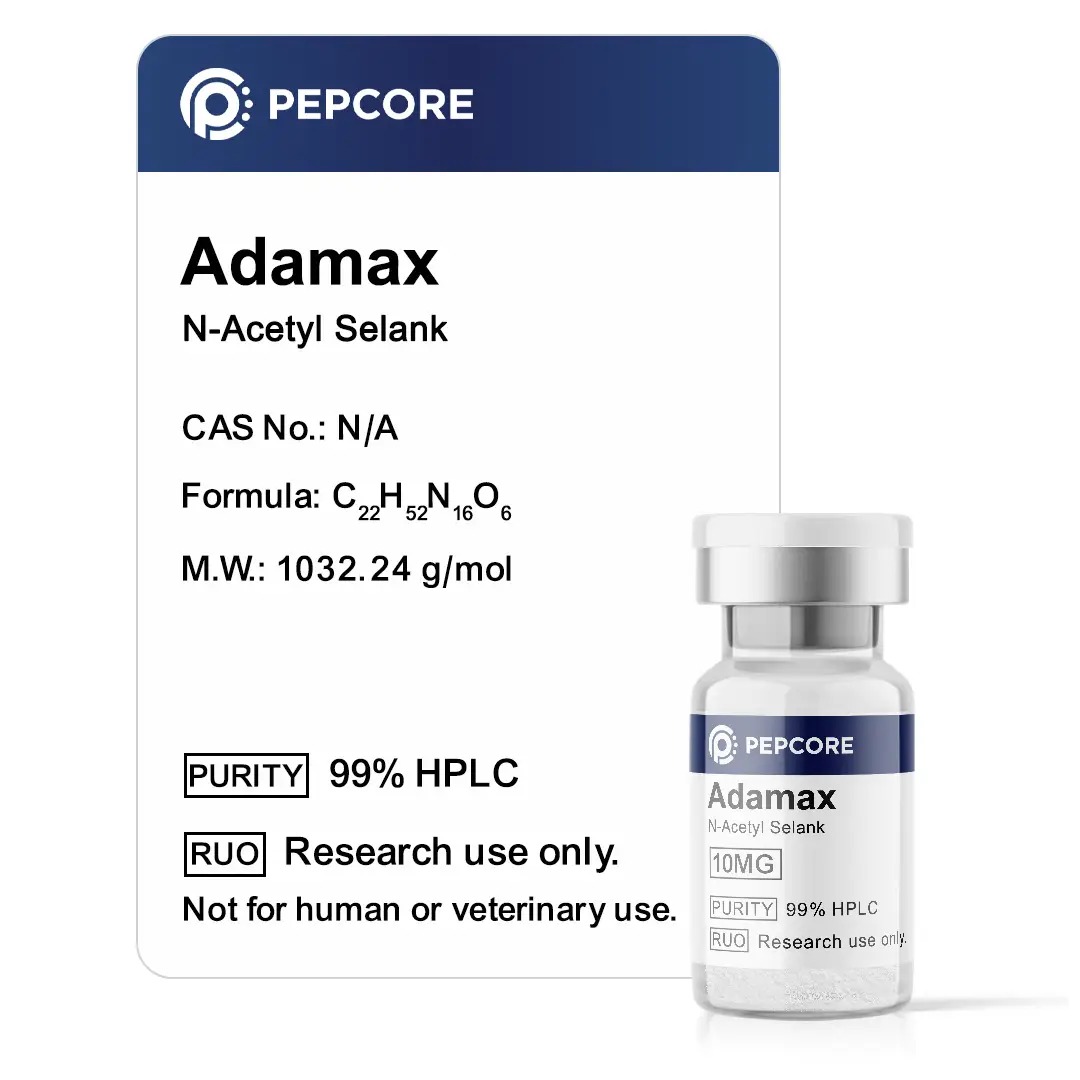
Adamax research peptide is a synthetic ACTH-analogue peptide studied in experimental neurobiology and cognitive-research settings. It is classified as a synthetic neuropeptide analog and is commonly discussed alongside Semax and other ACTH-derived compounds in laboratory work.
Research literature describes Adamax as a peptide designed to support neuronal microtubule stability and to engage endogenous neurotrophic signaling. Experimental work in this peptide class has examined modulation of BDNF and NGF release, TrkB receptor sensitivity, and downstream ERK pathway activity. Additional studies have explored regulation of GSK-3β phosphorylation and the influence of these analogues on inflammatory and oxidative-stress pathways. Together, these mechanisms position Adamax as a laboratory tool for probing neuronal cellular-response signalling and synaptic plasticity, frequently compared with anxiolytic heptapeptide research in adjacent cognitive-pathway models.
Research interest in Adamax research peptide centers on its use as a cognitive-research-oriented ACTH analogue in exploratory preclinical contexts. Semax-related literature has reported modulation of BDNF/TrkB-associated signaling and broader gene-expression changes in rat brain models, providing a comparative framework for Adamax investigations (Dolotov et al., 2006, Journal of Neurochemistry). Transcriptomic studies on Semax have also reported effects on genes linked to immune and vascular responses in rat focal ischemia models, which further supports cautious, mechanism-oriented language when positioning Adamax alongside neural bioregulator peptides in research settings.
The peptide is supplied as a lyophilized powder to ensure optimal stability during storage and handling.
See also: Semax 10 mg, Selank 10 mg, and Pinealon 20 mg.
Specifications
- Purity: 99%
- Quantity: 10 mg
- Molecular Formula: C₂₂H₅₂N₁₆O₆
- Molecular Weight: 1032.24 g/mol
Reviews
There are no reviews yet.