
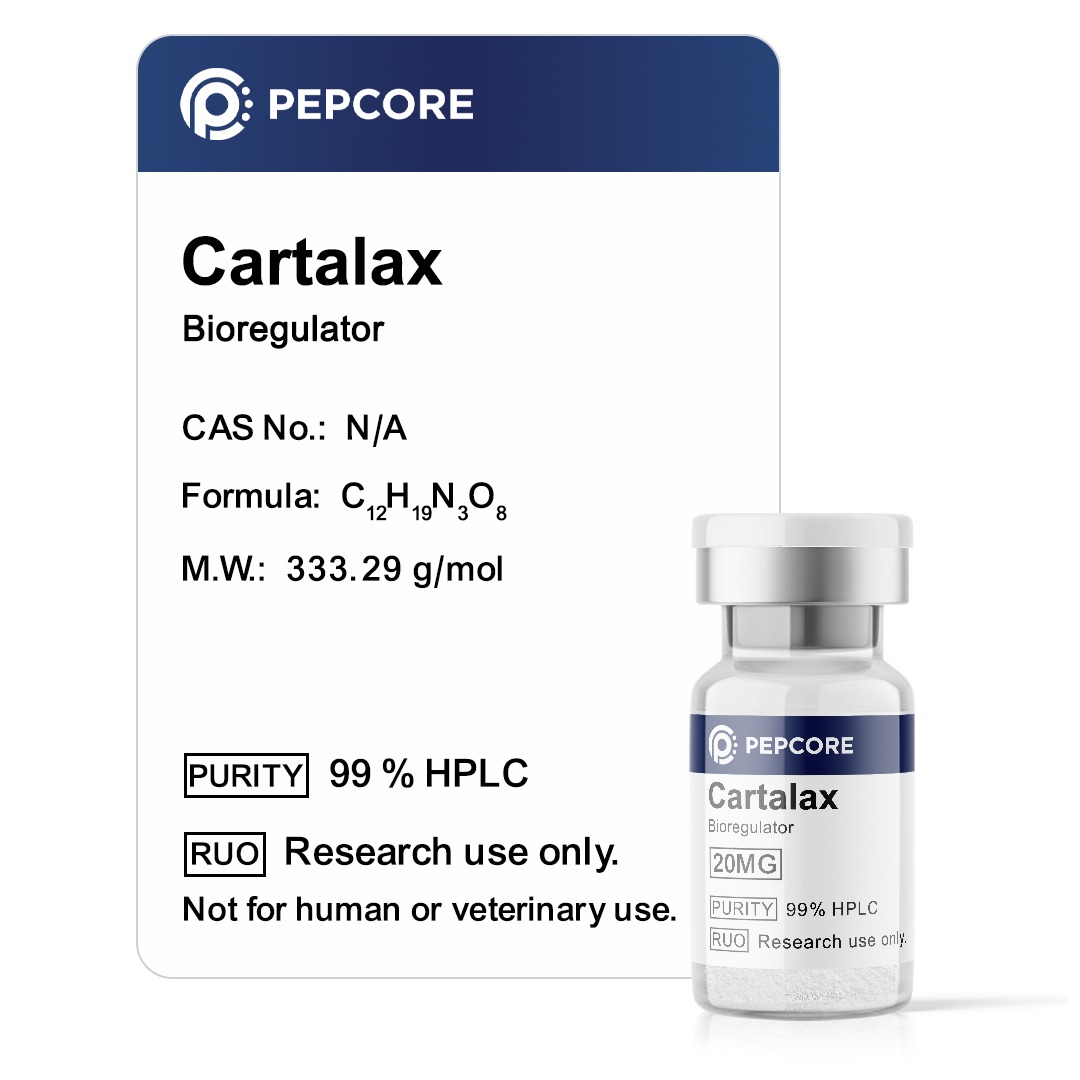
Cartalax is a short peptide bioregulator developed within the Khavinson school of peptide research at the Saint Petersburg Institute of Bioregulation and Gerontology. Classified as a synthetic tripeptide with the sequence Ala-Glu-Asp (AED), Cartalax was developed to investigate how minimal peptide sequences interact with cartilage tissue and connective-tissue research models. Although it shares the AED sequence with Cardiogen, within the Khavinson framework Cartalax is treated as a distinct compound with a separate tissue-selectivity profile focused on chondrocyte and connective-tissue cell systems. Its compact structure positions Cartalax as a useful research compound for studying tissue-specific peptide signaling in laboratory contexts.
At the cellular and molecular level, Cartalax is studied for its proposed ability to engage with chromatin structure and modulate transcriptional activity within chondrocytes and connective-tissue cell models. Research observations within the Khavinson framework suggest that short bioregulator peptides interact with specific DNA regions to influence the expression of genes associated with cartilage matrix organization, chondrocyte renewal, and extracellular-matrix protein synthesis in joint-derived cell systems. These observations are consistent with the broader proposition that short peptides act as gene-expression regulators within tissues from which their parent peptide complexes were originally extracted.
Research interest in Cartalax centers on cartilage-tissue gene expression studies, connective-tissue cellular research models, and extracellular-matrix investigations. Comparative work on tissue-specific bioregulators positions Cartalax alongside other connective-tissue-targeted oligopeptides used to explore peptidergic regulation of cartilage biology in cell-culture and animal research models (Khavinson V.K., Anisimov V.N., 2009, Advances in Gerontology). Additional reports within the Khavinson tradition describe how the AED sequence influences chondrocyte gene-expression profiles in cartilage research models, supporting continued laboratory investigation of Cartalax in connective-tissue and joint biology research.
The peptide is supplied as a lyophilized powder to ensure optimal stability during storage and handling.
See also: Cardiogen 20 mg, Cortagen 20 mg, and Livagen 20 mg.
Specifications
- Purity: 99%
- Quantity: 20 mg
- Molecular Formula: C₁₂H₁₉N₃O₈
- Molecular Weight: ~333.29 g/mol
Reviews
There are no reviews yet.